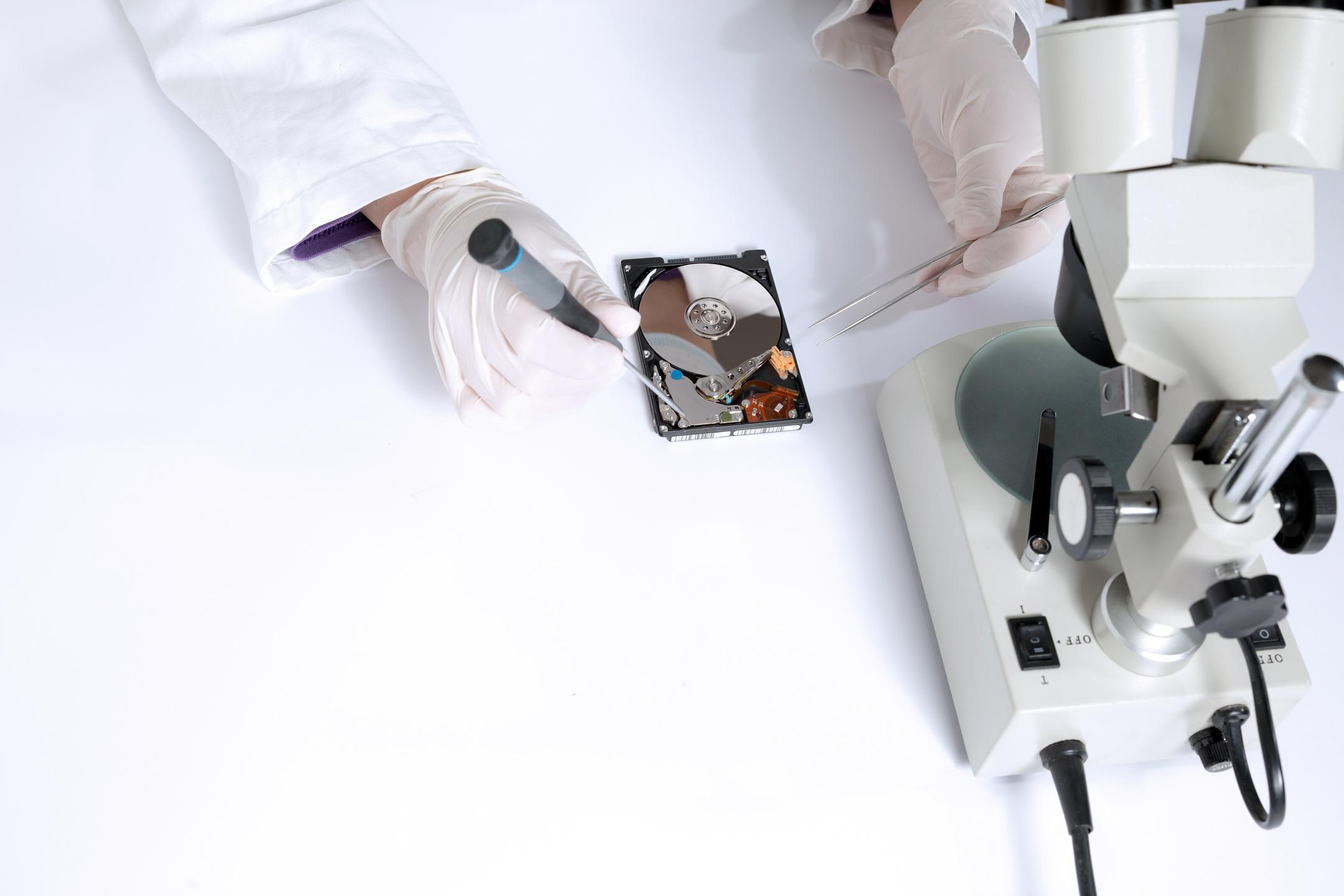
Our lab
Why it works here
Nearly 20,000 donor drives, X-ray and rework in-house, software we developed ourselves and a mobile cleanroom. Nearly forty years of equipment and experience, in one lab in Ypres.
Recovery
Hard disk and SSD HDD, SSD, external drives, flash cards RAID, NAS & SAN All levels, all controllers, virtualisation Smartphones and tablets iPhone, Android, iPad, Huawei Tapes LTO, DAT, DLT and older formats
Access after signing in.
EN · RU · ZH · ES
Our lab
Nearly 20,000 donor drives, X-ray and rework in-house, software we developed ourselves and a mobile cleanroom. Nearly forty years of equipment and experience, in one lab in Ypres.
Data recovery is custom work. Whether it succeeds depends on what a lab has in house the moment your device is on the bench. This is what is ready here.
The right part is usually already on the shelf. No weeks of waiting for a donor from abroad.
We see the break, the layer and the contacts before we take anything apart.
Removing and refitting chips and controllers safely, even on multilayer boards.
From Recover, free for everyone, to Three-Tier Recovery for hundreds of terabytes.
RAID, NAS and ZFS pools too large for ordinary tools.
We come to you. The device never leaves your building.
For you that means less guesswork, faster results and, in difficult cases, results more often.
A mechanical fault needs parts from a drive of exactly the same model, often with the same firmware revision and production batch. Read heads from another version rarely work.
In nearly forty years in the trade we have built up a stock of nearly 20,000 donor drives. So the matching part is usually already in the lab. That makes a recovery faster, and keeps a case from stalling because a rare donor cannot be found.
Modern drives are calibrated at the factory to their own heads and platters. That calibration lives partly in the firmware and partly on the platters themselves. A head stack from another revision therefore often cannot read, or damages the platters. The right model, the right revision and sometimes even a compatible production week make the difference.
Recovery is becoming more and more electronic. Monolithic memory cards, glued phones and multilayer circuit boards do not show their problems on the outside.
With X-ray inspection we see where a break is and where the contact points lie, without opening anything. With rework and reballing stations we safely remove chips from a damaged board, apply new solder balls, and refit them or read them directly. One wrong move on a damaged board is final. That is why we work with sight first, and only then with the soldering iron.
Standard software stops where the structure of a drive is damaged, or where the volume becomes too large. That is why we develop our own tools.
Recover is our software for logical problems, a free download for Windows, macOS and Linux. Three-Tier Recovery is our own system for very large volumes: it spreads the work over several machines and joins the pieces it finds back into files. We also use our own equipment to read and image damaged devices.
A 40 TB RAID system or a ZFS pool of 100 TB and more cannot be recovered on a single workstation. Scanning alone would take weeks, and the memory of an ordinary computer is not enough to keep track of the structures.
With Three-Tier Recovery we spread the work over several machines, each processing part of the volume. That keeps even a project of hundreds of terabytes feasible, with a predictable turnaround.
For banks, pharma, government and institutions where no device may leave the building, we come on site, with a mobile cleanroom.
The recovery takes place in your building. And the donor drives we use stay with you: not a single part containing your data leaves.
Datarecuperatie started in 1988, developing and repairing electronics. Since 2005 recovering data is all we do. Every generation of storage brought its own equipment, and we kept it. So we can still read older systems, tapes and formats.
Fellow labs send us their hardest electronic cases. And a case closed elsewhere as unrecoverable regularly still yields data here.
For simple logical problems our prices are sharp. For complex cases the price follows the difficulty: donors, X-ray, rework and computing power cost money, and make the difference between a result and none.
What always applies: the analysis is free, you get a fixed price before we start, and if we find nothing, you pay nothing.
The analysis is free. You hear what is wrong and what it costs before you decide anything.